Monday, September 10, 2012
June 11th: Modernism in Architecture
The City University International aimed to unite students and create peace after World War I by inviting students from different countries to study together. It is fitting that a school with such a diverse student population also features diversity in architecture. The building on the City University’s campus, many of which were designed by architect Corbusier, serve as documents of the movements in architecture in the early twentieth century.
An important element of modern architecture is the altered perspective of the building. In traditional architecture, it was possible to understand the structure of a building from viewing the outside. In modern architecture, an observer must walk through the building to understand it’s structure. One main reason for these changes is the building of columns below the ground to support buildings. This allowed architects more possibilities in building above ground. Modern architecture began to take on features such as large glass windows and columns, which expanded the spaces.
During the early twentieth century, cubist painters were attempting to represent multiple perspectives on a single canvas. They used geometric shapes and lines to create two-dimensional paintings that felt three-dimensional. Much like cubist painters, modern architects like Corbusier were expanding the perspectives on buildings. The increased use of glass allowed people to see through the buildings and connected the spaces effectively. Lines became important as devices to draw the eye toward aspects of the architecture.
Perhaps the most obvious influence of cubism in architecture is in the brutalist movement of architecture. Brutalist buildings emphasized their three-dimensional qualities with slabs of concrete jutting out from buildings and strong lines. Much like a cubist painting, it becomes difficult to land one’s eye on a particular feature of a brutalist building; viewing it is an overwhelming sensory experience.
June 10th: First Impressions
What an eventful few days it has been! Having coming this class with only a small amount of background knowledge on modern art, and being that this is my first trip across the Atlantic Ocean, I was unsure what to expect. From walking around the streets of Paris and interacting with Parisians in the best way my broken French will allow me, I feel I am getting a better sense of the culture that defines this city.
In reflecting upon my time in Paris, I cannot help but compare my experiences with the depiction of Paris in one of my favorite movies, Paris Je T’aime. This movie is a collection of short stories by various directors giving their view of Paris, and often uncovering the rarely told stories occurring on the streets. One such short story documents a middle-aged American lady, Carol, who travels to Paris, a place she has dreamed about traveling her whole life. While sitting in a picturesque park, observing the happy couples around her, and eating a baguette, Carol describes feeling joy and sadness at the same time. A feeling she says has been missing all her life, or perhaps a feeling she has forgotten over the years. Carol summarizes this feeling as being “alive.”
I enjoyed this description, because it does not rest on cliches to describe the feeling of being in Paris. Similar to New York, Paris has can be rough around the edges and intimidating, but it is a place that ultimately endears itself to you though the exhilarating liveliness felt throughout the city.
Of course, the art I have had the pleasure to observe has been an amazing experience. The standout for me is not one piece of art, but rather the connection between art forms I have been able to make. Normally, art is taught compartmentalized by medium and these connections are lost. It is incredible to see how the works of painters, dancers, composers, writers, photographers and filmmakers can be viewed together as expressing a similar viewpoint and discontent with the traditional dialogue in art.
June 9th: Haussmann's Paris
The invention of the camera and Eugene Atget’s exploration of the “old Paris” could not have been more timely, as the layout and structure of Paris would soon be altered in favor of a city that reflected the modern era. Napoleon commissioned Georges-Eugene Haussmann to rebuild Paris in order to make the city more modern as well as to facilitate better hygiene. The most noticeable in the new layout of Paris was the emergence of the wide boulevards. Before the reconstruction, Paris was compromised of mainly small, narrow streets. Napoleon favored the wide boulevards for security reasons; he felt he could better protect against civil war in Paris if the army was able to easily march through the streets.
During the reconstruction, Haussmann also brought water and plumbing into Paris. This significantly improved the cleanliness of the city and the hygiene of the Parisians. Making the city more attractive was important to Napoleon, as he wanted to keep up with the modern architecture appearing throughout the world, especially in New York City.
As the streets of Paris widened, Haussmann made sure to add features that aided the Parisians in navigating around their new cities. One such feature was the presence of a monument at the end of each wide boulevard. These monuments improved the beauty of the city as well as providing directional cues to orient oneself. Another new feature for the directionally savvy was the emergence of passageways. These passageways acted as shortcuts for the Parisians and also connected the building and residents of Paris in a new way.
Perhaps the most important new building built in the nineteenth century was the Opera House. This was not only because Napoleon’s private apartments were located here, but also because of the architectural features of the building. The Opera House reflected the moment at which is what built and the intersect of traditional and modern that was happening at the time. The building is made of a mix of the traditional marble and the modern iron. It also reflected the pride of Paris. The bust of many famous composers can be seen on the Opera House, as well as the incorporation of boats into the architecture, which were the symbol of Paris. The Opera House was a building the Parisians could be proud of and unite over.
June 8th: Eugene Atget
Eugene Atget is famous for his many pictures documenting Paris as it was modernizing at the turn of the 20th century. Perhaps his work is best described by what it did not feature as opposed to what it did; his photographs of Paris omitted any pictures of the Eiffel Tower and the Opera House. Atget’s pictures idealized the old Paris and the magical moments that occurred in the streets of Paris. Atget’s photographs have been associated with the surrealist movement by some, but Atget saw his work as documents of Paris rather than pieces of art.
Atget’s photograph Fontaine de l'Observatoire captures the playfulness that can be seen in many of his pictures. This photograph focuses on a sculpture horse and a turtle that are part of the same fountain. The framing of the two subjects in this picture draws attention to the fact that these two sculptures are facing each other and gives the impression that they are interacting. The interaction of people in the streets of is the subject of many of Atget’s photographs, and Fontaine de l'Observatoire broadens this subject to the architecture of the city. Through his documents of Paris, Atget creates a world where the people, sculptures, buildings and history of the city are seen as connected.
This connection between the people of Paris can be observed in the photograph Pendant l'Eclipse. This pictures represents a group of people collectively staring toward the sky, and as the name indicates, watching the eclipse. The photograph also showcases a technique that is common is Atget’s work. He often uses a slower shutter speed, which blurs the motion in a photograph. In Pendant l'Eclipse, the slow shutter speed blurs the faces and bodies of many of the figures. This gives the photograph a ghostly and surrealist quality. This photograph also features the development process of Atget. He chose to develop many of his prints in natural light, which gives them a violet-brown. This tint is what might now be interpreted as sepia, and is associated with ideas of the old-fashioned and historic.
June 7th: Le Guitariste
At the Pompidou, we observed an exhibition of cubist paintings by Braque and Picasso. One such painting is Le Guitariste by Picasso. The cubist movement aimed to explore the possibilities of what paintings could offer beyond two-dimensional representation. Many considered these paintings to abstract, but the artists felt their works were connected with reality. Their realities, however, were connected with an alternative dimension- cubist paintings were meant to connect with the “feeling” around a three-dimensional object.
Le Guitariste by Picasso, as the name indicates, is Picasso’s depiction of the three-dimensional space around a guitar. This painting holds value because of the artistic influence Picasso imparted on the work. Upon first impression, it is difficult to uncover to subject of this painting, but the title and knowledge of the cubist ideal inform us that this is how Picasso sees a guitar. This creates an interesting dynamic for the observer, as we are allowed a glimpse into a alternative reality as Picasso views it.
Le Guitariste also holds value in the scientific history it connect with. Around the time of this paintings creation scientists were beginning to uncover a sub-atomic level to the world around us. The discovery of the atom opened up the minds of the artists of the time. Cubists were fascinated by the idea that there was a microscopic world they could capture. This painting by Picasso attempts to depict a sub-atomic world through the use of geometrical shapes and strong lines.
The techniques of this painting also connect with a larger movement that span across modernism: the pursuit of alternate forms of representation. Le Guitariste fails as a traditional picture of a guitar, but it succeeds in how the artist has offered the observer with a new and exciting way to view an ordinary object. The painting is important because of the ideas it connects with and the vision it proposed for the future possibilities of representation in artwork.
June 6th: Courbet and Manet
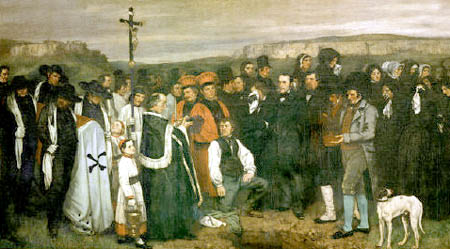
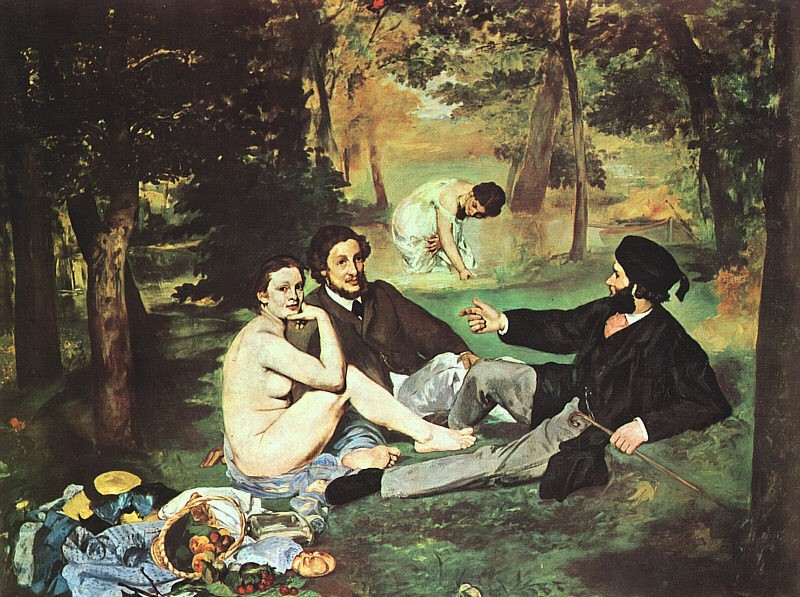
The collection at the Musee d’Orsay, a former train station converted into a museum, spans from Neoclassicism and Romanticism to Modern Art. This museum also features paintings by Courbet and Manet, which disrupted the painting conventions of the classical era. Perhaps the most striking difference between the classical paintings and the modern paintings of Courbet and Manet can be seen in the painting techniques. Classical paintings sought to distract the observer from the idea they were looking at a painting by disguising the brushstroke. The paintings by Courbet and Manet stand out in comparison; evidence of the brushstroke can be seen in their works.
Another convention ignored by both artists was the traditional subject matter artists were expected to address. Painters were allowed to capture a subject that existed above reality; references to religion and mythology were essential parts of accepted artworks. Through their unconventional methods, Courbet and Manet proposed that art could be about reality. This can be seen in the work Funeral by Courbet. This painting is on a rather large canvas, and it features a group of ordinary people attending a funeral. The subject in this painting is not the history or mythology to which it refers, but rather the moment in time that it captures. In this style, elements such as composition and technique become central to the reading of the work.
Manet tackles this “crisis of the subject” in his work Luncheon on the Green. At the time of its creation, this painting was considered to rather controversial because it contains an undressed woman in the presence of two clothed men. With reference to antiquity, featuring a naked woman was allowed, but this painting provides no context for this unnatural situation. This lack of strong subject matter allowed Manet to focus on painting techniques and compositions. This change in approach from artists like Courbet and Manet changed the dialogue of painting as the art world transformed from the classical to the modern era.
Subscribe to:
Posts (Atom)